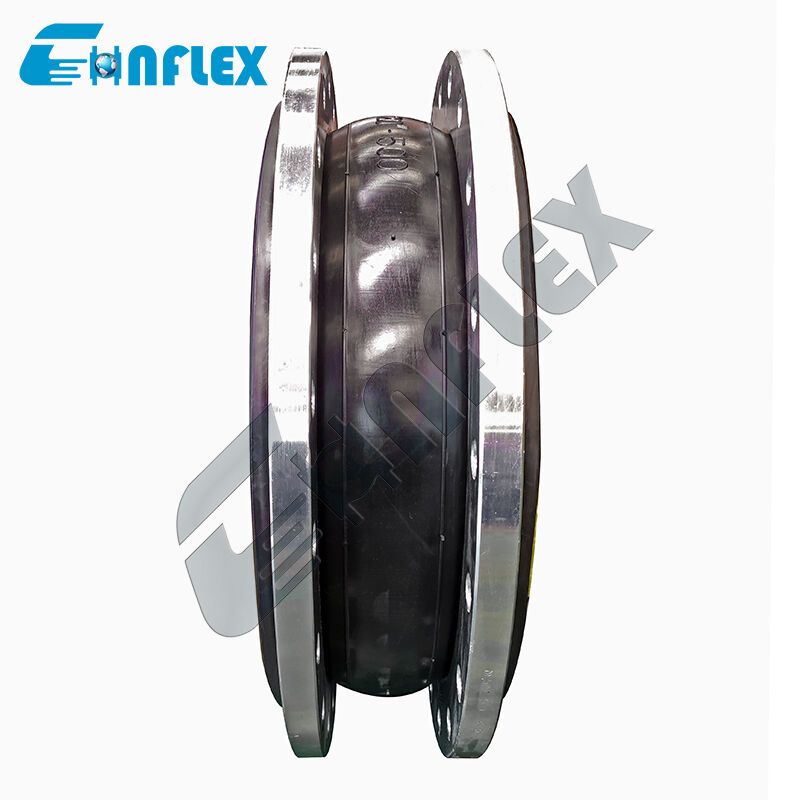
Class 300 Pressure Rating Reinforced Rubber Expansion Joint: Ultra-Durable Thermal Growth Compensator for Refineries
Heavy-Duty Thermal and Pressure Stress Relief for High-Pressure Refining Lines.
The Class 300 Pressure Rating Reinforced Rubber Expansion Joint is an ultra-durable, heavy-duty pipeline growth compensator purpose-built for the extreme working conditions of petroleum refineries, petrochemical units, and high-pressure chemical facilities. Operating under ASME Class 300 standards requires structural integrity that far exceeds standard commercial joints. These severe-service lines face intense thermal expansion cycles, high working pressures, hydraulic shock, and constant mechanical vibration from heavy-duty compressors and transfer pumps.
Constructed with an extra-thick, multi-layered elastomeric body reinforced by embedded high-tenacity synthetic cord plies and solid internal steel restraint rings, this expansion joint maintains high pressure containment up to Class 300 operating envelopes without ballooning or deforming. Equipped with thick, precision-machined ASME B16.5 Class 300 carbon steel or stainless steel backing flanges, it acts as a flexible, vibration-dampening bridge that absorbs complex multi-axial pipe movements, prevents nozzle fatigue on critical turbomachinery, and ensures long-term zero-leakage security across high-stress refinery infrastructure.

Performance characteristics
ASME Class 300 Structural Rating: Precision-engineered with heavy-wall reinforcement layers to operate within ASME B16.5 Class 300 pressure-temperature limits, delivering continuous, reliable pressure containment under high-stress conditions.
Heavy-Duty Multi-Ply Reinforcement: Built with high-tensile synthetic cord plies and embedded high-strength steel wire/ring reinforcement, preventing radial expansion, structural deformation, and pressure surge rupture.
High-Capacity Thermal Growth Relief: The engineered flexible arch configuration smoothly absorbs large thermal growth shifts, simultaneously compensating for axial compression, axial extension, lateral shearing, and angular pipe misalignments.
Exceptional Vibration & Shock Damping: The thick elastomeric matrix acts as an effective kinetic energy absorber, isolating heavy machinery vibration, motor hum, and sudden hydraulic pressure pulsations right at the source.
Refinery-Grade Chemical & Media Resistance: Formulated with high-grade synthetic elastomeric compounds (such as hydrogenated NBR, Neoprene, EPDM, or specialized liners) that resist hydrocarbon derivatives, process oils, steam, and aggressive refinery fluids.
Product Specification
| Size |
Length |
Allowable Movements in Operation |
| mm |
inch |
mm |
Axial Compression mm |
Axial Extension
mm |
Transverse Movement
mm
|
Angular Deflection mm |
|
| 25 |
1 |
130/152 |
20 |
12 |
14 |
15° |
| 32 |
1 1/4 |
95/130/152 |
20 |
12 |
14 |
15° |
| 40 |
1 1/2 |
95/130/152 |
20 |
12 |
14 |
15° |
| 50 |
2 |
105/130/152 |
20 |
12 |
14 |
15° |
| 65 |
2 1/2 |
115/130/152 |
20 |
12 |
14 |
15° |
| 80 |
3 |
130/135/152 |
20 |
12 |
14 |
15° |
| 100 |
4 |
130/152 |
20 |
12 |
14 |
15° |
| 125 |
5 |
130/152/165 |
20 |
12 |
14 |
15° |
| 150 |
6 |
130/152/185 |
20 |
12 |
14 |
15° |
| 200 |
8 |
130/152/210 |
20 |
12 |
14 |
15° |
| 250 |
10 |
130/203/230 |
20 |
12 |
14 |
15° |
| 300 |
12 |
130/203/245 |
25 |
16 |
22 |
15° |
| 350 |
14 |
200/255 |
25 |
16 |
22 |
15° |
| 400 |
16 |
200/255 |
25 |
16 |
22 |
15° |
| 450 |
18 |
200/255 |
25 |
16 |
22 |
15° |
| 500 |
20 |
200/255 |
25 |
16 |
22 |
15° |
| 600 |
24 |
260 |
25 |
16 |
22 |
15° |
| 700 |
28 |
260 |
25 |
16 |
22 |
15° |
| 800 |
32 |
260 |
25 |
16 |
22 |
15° |
| 900 |
36 |
260 |
25 |
16 |
22 |
15° |
| 1000 |
40 |
260/300 |
25 |
16 |
24 |
15° |
| 1100 |
44 |
300 |
25 |
16 |
24 |
15° |
| 1200 |
48 |
300 |
25 |
16 |
24 |
15° |
|
Note: If the medium is oil, acidic or alkaline substances, and there are special requirements for the working temperature, you can customize it by sending a letter or drawing. Please specify when ordering
|
Product Details
Production Flow
|
1.Raw material
Top level CR/EPDM/NBR
rubber raw materials,
No recycled rubber
|
2.Plasticating and mixing
Special Formulation for better Bending with Nylon,For Better Strength,Sealing
|
3.Workblanks wraping
Cooper plated steel wire reinforcement prevent pull off
|
|
4.Vulcanizing
Automatic vulcanization machine ensure vulcanization time and pressure
|
5.Inspecting
100% strict inspection is to be responsible for consumers
|
6. Packaging
Protective Packaging for No
Rust and Breakage
|
Application
Rubber Expansion Joint Standard are widely used in various fields, including construction, chemical industry, shipbuilding, tap water, gas, chemical pipelines, petroleum pipelines, food pipelines, air conditioning pipelines, and sewage treatment.
Our Services
1.24-hour online
2.Free samples provided
3.Support customization
4.Provide drawings
5.Multiple payment styles to choose from
6.Factory inspection (material, specifications, quantity, pressure, packaging)
7.Long warranty period
8.Suitable packaging for transportation
Our Customer
Certificate
FAQ
Q1: What working pressure does a Class 300 rating represent for this rubber expansion joint?
An ASME Class 300 rating corresponds to a maximum working pressure profile of up to 740 PSI (5.1 MPa) at ambient temperatures, depending on the flange material grade and temperature derating factors set by ASME B16.5 standards.
Q2: Why are control units (limit rods) mandatory for Class 300 expansion joints?
Under Class 300 operating pressures, the pressure thrust forces exerted inside the pipeline are extremely high. Control units (tie rods) act as structural safety stops anchored across the expansion joint flanges. They prevent the flexible rubber arch from over-extending or over-compressing beyond its design limits during pressure surges or thermal cycles, protecting both the joint and unanchored piping equipment.
Q3: How does this joint protect expensive refinery equipment like pumps and compressors?
High-pressure refinery piping expands significantly when exposed to hot process fluids, generating massive mechanical loads. If connected directly to pump or compressor nozzles, these forces cause shaft misalignment, seal failure, and casing cracks. This Class 300 flexible joint absorbs those thermal stresses and mechanical vibrations before they reach the machinery.
Q4: Can this Class 300 joint be equipped with a PTFE liner for aggressive chemical service?
Yes. For severe refinery applications involving sour water, aggressive acids, or volatile organic solvents, the internal tube can be integrated with a heavy-duty virgin PTFE liner during vulcanization. This creates a dual-defense barrier—PTFE for absolute chemical immunity and reinforced rubber for high-pressure flexibility.
Q5: Are the backing flanges compatible with standard US refinery piping?
Yes. The attached heavy-duty backing flanges are precision-drilled to match ASME/ANSI B16.5 Class 300 bolt circle dimensions, hole diameters, and thickness specs, ensuring seamless bolt-on integration into standard high-pressure industrial piping systems.


 Your message must be between 20-3,000 characters!